Allowable bearing pressure and settlement explained
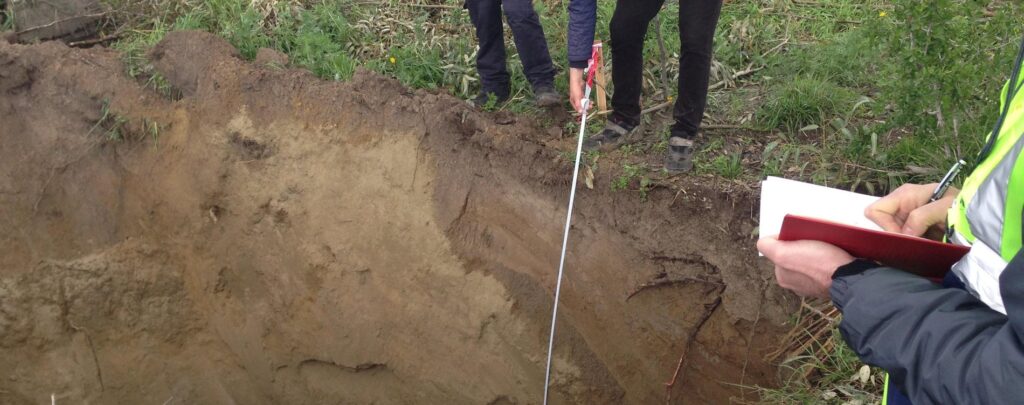
“What is the bearing capacity of the plot?” is one of the first questions owners and builders ask us, usually expecting a single number. In practice the allowable bearing pressure and the settlement of a foundation depend as much on the foundation as on the ground. This guide explains the basic terms, the data behind the assessment and why the design values are set by the project’s geotechnical engineer. It contains no design calculations.
The basic terms
| Term | What it means |
|---|---|
| Bearing capacity (ultimate bearing resistance) | The pressure at which the ground under a foundation fails in shear: the foundation sinks and the soil beside it is pushed up and aside. |
| Allowable bearing pressure | The pressure a foundation may apply with an adequate margin against bearing failure and with a tolerable settlement; the stricter limit governs. |
| Settlement | The downward movement of a foundation as the ground beneath it compresses. |
| Differential settlement | The difference in settlement between two points of a structure; it, more than total settlement, is what cracks walls. |
| Heave | Upward movement of the ground, for example when an expansive clay takes up water. |
Pressures are normally reported in kPa (kN/m²). Older reports often use kg/cm²; 1 kg/cm² is about 98 kPa.
Why a plot has no single bearing value
The allowable bearing pressure is not a property of the plot in the way its area is. On the same ground it changes with:
- the width and shape of the foundation (strip, pad or raft);
- the founding depth;
- the groundwater level and its seasonal changes;
- the loads and how they are spread;
- the settlement the structure can tolerate.
A wider foundation stresses the ground to a greater depth, so a soft layer a few metres down may hardly affect a strip footing yet govern the settlement of a raft. Likewise, the modulus of subgrade reaction used in structural software is not a soil constant: it depends on the size and stiffness of the foundation. Every value in a report holds only for the foundation assumptions behind it.
Two checks: bearing resistance and settlement
Every foundation is checked in two ways. Bearing resistance: the ground must not fail under the foundation and, on a slope or beside an excavation, must stay stable as a whole. Settlement: total and differential settlement must stay within what the structure tolerates. On the clays and marls common in Cyprus, settlement, swelling and softening on wetting often govern long before bearing failure; see our guide to ground in Cyprus: marl and expansive clay.
Settlement has more than one cause:
- Immediate settlement occurs as the load is applied and dominates in sands, gravels and rock.
- Consolidation settlement develops in saturated clays over months or years as water is squeezed out of the pores.
- Volume change caused by water, not load: swelling and shrinkage of expansive clays, and softening of some marls when wet.
Eurocode 7, TS EN 1997-1, treats the two checks as ultimate and serviceability limit states, with partial factors on loads, ground properties or resistances; the design approach and factor values follow the national annex and the regulations for the project. The familiar “allowable bearing pressure” comes from the traditional approach, in which the ultimate value is divided by a global factor of safety and then checked for settlement. Which approach is used, with which values, is the geotechnical engineer’s decision.
Site data that feed the assessment
The geotechnical engineer builds a ground model from the fieldwork. Its main inputs are:
- Layer profile: the type, thickness and boundaries of each layer from boreholes and test pits, classified on the logs to TS EN ISO 14688-2:2018 (soils) and TS EN ISO 14689 (rock).
- SPT N values: in the standard penetration test to TS EN ISO 22476-3, N is the blow count for 300 mm of penetration after the seating drive. It indicates density or consistency, not a bearing pressure.
- Rock cores: core recovery (TCR, SCR), RQD, weathering and discontinuities, with core-box photographs.
- Groundwater: the level when first struck and after it stabilises; water reduces the effective stress and can soften marl.
- DCP profiles: shallow layer thicknesses and soft spots near founding level, to ASTM D6951/D6951M-18(2023); the estimated CBR is a pavement parameter.
- Site observations: fill, old excavations, slopes, neighbouring buildings, trees and drainage.
Laboratory data, and where they stop
Samples from each layer are tested in our laboratory. The results show what each soil is and its present state.
| Test | Standard | Use in the assessment |
|---|---|---|
| Water content | TS EN ISO 17892-1:2014+A1:2022 | Present state; read against the Atterberg limits, how stiff or soft a clay is |
| Atterberg limits | TS EN ISO 17892-12:2018+A2:2022 | Plasticity; an indicator of compressibility and sensitivity to water |
| Particle size distribution | TS EN ISO 17892-4:2016 | Whether a layer behaves as a coarse or a fine soil |
| Bulk density | TS EN ISO 17892-2:2014 | Unit weight, for the stresses in the ground |
| Particle density | TS EN ISO 17892-3:2016 | With density and water content: void ratio and degree of saturation |
| Linear shrinkage | BS 1377-2:2022 | Tendency of a clay to change volume |
| Soil classification | TS EN ISO 14688-2:2018 | Consistent naming of layers across all test points |
These are index tests: they do not measure strength or compressibility directly. Parameters derived from them, or from SPT N, rest on correlations developed for particular soils; none is universally valid. In gravelly, cemented and marl layers a high N may reflect a gravel particle or a hard band, so N is read with the log, the cores and the laboratory results. TS EN 1997-2 covers how ground parameters are derived. Where measured strength or compressibility is needed, the geotechnical engineer may specify tests on undisturbed samples, such as oedometer or shear tests.
Ground conditions that need extra care
- Uncontrolled fill: variable and liable to settle under its own weight; foundations are usually taken through it, or it is replaced.
- A soft layer under a stiff crust: the dry surface looks strong, but a softer layer below can govern settlement, especially under wide foundations.
- Slopes and nearby excavations: bearing resistance is lower and overall stability must be checked.
- High or seasonal groundwater: it lowers bearing resistance, softens marl and complicates excavation.
- The active zone of expansive clay: the depth over which the water content changes with the seasons; shallow foundations within it can move whatever the load.
What a good report states, and who designs the foundation
A useful geotechnical report does more than give a number. It states:
- the foundation assumptions behind each value: type, width and depth;
- the recommended founding layer and depth;
- the basis of each parameter: the test, correlation or reference, and the test points it covers;
- the groundwater conditions and seasonal effects;
- the limits of validity and the checks during construction, such as inspecting the exposed formation before blinding concrete is poured.
If the design changes (a basement, a larger footprint, higher loads, a raft instead of pad footings), the assessment is revisited and more test points may be needed. Our guide on how to read and verify a test report explains how to check the report itself.
The roles are distinct. We plan the fieldwork with you, drill, sample and test, and report the results with our assessment of the ground conditions. The project’s geotechnical engineer derives the design parameters, checks bearing resistance and settlement and sets the allowable bearing pressure for the chosen foundation; the structural engineer then sizes the foundations. The applicable code and the authority set the minimum requirements.
How we can help
We carry out geotechnical drilling with SPT, sampling and rock coring, test pits and DCP testing within our site investigation service, and the tests on our soil laboratory testing page. To agree a scope, send us the site plan, the building outline, the storeys and any basement, the intended foundation type and earlier reports through our contact page.
Frequently asked questions
Can you give one bearing value for my plot?
Not without the foundation assumptions. The same ground gives different values for a strip footing and a raft, at different depths and settlement limits. Tell us what is planned; the design value is set by the project’s geotechnical engineer.
Does a high SPT N or refusal mean we have reached rock?
Not necessarily. In Cyprus, dry marl, cemented bands and gravel can give high blow counts or refusal. Coring a set length into the layer, with recovery and RQD recorded, shows whether it is rock and of what quality.
Does a DCP or LWD result give the bearing pressure?
No. The DCP gives penetration resistance and an estimated CBR for pavement layers, and the Evd from our Zorn ZFG 3.1 LWD to ASTM E2835-21(2026) is used for compaction control. Neither is a foundation bearing pressure.