Road construction quality control: tests for each layer
A road is built in layers, and each layer is covered by the next within days. Once the asphalt is down, nobody can see whether the sub-base was compacted or the fill was the approved material. Quality control therefore runs alongside construction: materials are approved before use, each layer is tested before it is covered, and the asphalt is sampled on the day it is laid. This guide shows which test belongs to which layer with its standard; on every job the project specification sets the frequency and the limits.
The layers and what each must achieve
A typical flexible pavement has some or all of the layers below, from the bottom up. The pavement designer sets the materials and thicknesses; the specification turns them into measurable requirements.
- Subgrade or fill: the ground that carries the pavement. It must be uniformly compacted, free of soft spots and shaped to shed water; the design starts from its bearing capacity.
- Sub-base: a granular layer that spreads the load and protects the subgrade.
- Base: better-quality crushed aggregate, often plant-mixed, directly under the asphalt. It must be dense, stiff and finished to level.
- Bituminous base and binder course: the asphalt layers that carry much of the load; a bituminous base is included where the design calls for it.
- Wearing course: the surface. Besides thickness and compaction, it needs texture for skid resistance and must keep water out.
Before work starts: approving the materials
A field test only means something if the material was suitable and has a laboratory reference. Before placing starts, a representative sample from each source is tested and submitted to the supervising engineer for approval:
- Fill and subgrade material: classification (grading and Atterberg limits), the Proctor test for maximum dry density and optimum water content, and CBR and swell where specified. See our guide to Proctor, CBR and water content tests.
- Aggregate for sub-base and base: grading, Los Angeles coefficient, methylene blue value, particle shape and crushed particles, plus a Proctor test as the compaction reference.
- Asphalt: the job mix formula (JMF), prepared by the contractor or the plant and approved by the engineer, fixes the target grading and binder content of each mix. Its aggregates are tested too, with particle density and water absorption added.
Aggregate limits are often written as categories from the product standards TS EN 13242 (unbound and hydraulically bound materials) and TS EN 13043 (bituminous mixtures); the specification picks the category for each layer. A Proctor result belongs to one material: when the borrow pit or the quarry face changes, it must be renewed.
Earthworks layers: acceptance before the next layer
Each lift of subgrade, fill, sub-base and base is accepted on its own surface before the next one is placed:
- Degree of compaction by the sand cone test: the in-place dry density as a percentage of the Proctor maximum dry density of the same material, with its water content.
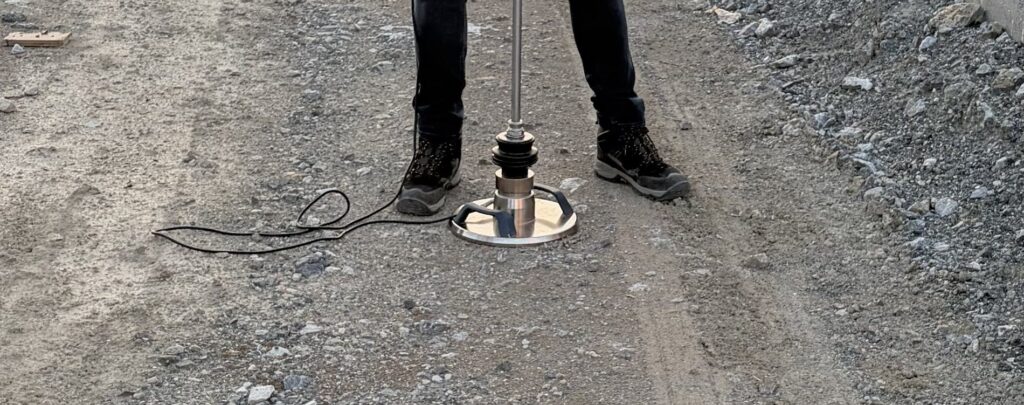
- Evd (dynamic deformation modulus) with the LWD: we use a Zorn ZFG 3.1 to ASTM E2835-21(2026). It measures stiffness, not density, and gives the result on site, so weak areas are found before they are buried. Where a degree of compaction is specified, it complements the sand cone test rather than replacing it.
- DCP profile: penetration resistance with depth, showing layer thicknesses and weak zones in the subgrade. The correlations in the appendix of ASTM D6951/D6951M-18(2023) give only an estimated CBR, valid for the soils they were derived from; they do not replace a laboratory CBR test. See site investigation and DCP.
The number and spread of test points and the acceptance values come from the specification. If it is silent, agree a written test plan with the supervising engineer before earthworks start, not after the first failure.
On the day of paving: hot-mix samples and the Marshall reference
A sample missed on the day of paving cannot be taken later, so sampling is planned with the paving programme. Hot-mix samples are taken at the plant, from the lorry or at the paver. Marshall specimens compacted from them give the reference density for cores where the specification uses it. Binder content and the grading of the recovered aggregate are compared with the JMF tolerances.
Mix temperatures and rolling records are kept by the contractor and checked by the supervising engineer. They are not our tests, but they often explain low core densities later.
After paving: cores and surface texture
Once the layer has fully cooled, cores are cut through the bituminous layers at locations set by the specification or the engineer. We then determine:
- the thickness of each layer, against the design thickness and tolerance;
- bulk density and the degree of compaction against the specified reference density;
- binder content and grading, where no hot-mix sample was taken;
- the macrotexture depth of the wearing course by the volumetric patch method, where the specification sets a texture requirement.
Coring and core-hole filling are covered in our asphalt coring and hot-mix testing guide.
Which test for which layer: summary table
In every row, the number of tests and the acceptance limits come from the project specification.
| Layer and stage | Tests and standards | Frequency basis | Service |
|---|---|---|---|
| Fill and subgrade material, before use | Grading (TS EN ISO 17892-4:2016), Atterberg limits (TS EN ISO 17892-12:2018+A2:2022), classification (TS EN ISO 14688-2:2018), Proctor (TS EN 13286-2:2013), CBR and swell (TS EN 13286-47:2021) | Per source; again if it changes | Soil laboratory |
| Aggregate for sub-base, base and asphalt, before use | Grading (TS EN 933-1:2012), LA (TS EN 1097-2:2020), MB (TS EN 933-9:2022), flakiness and elongation (BS 812-105.1:1989, BS 812-105.2:1990), crushed particles (TS EN 933-5:2022), density and absorption (TS EN 1097-6:2022) | Per source or stockpile; again if it changes | Aggregate testing |
| Subgrade, fill, sub-base and base, each lift | Degree of compaction (ASTM D1556/D1556M-24, TS 13872:2019+T1:2026), water content (TS EN ISO 17892-1:2014+A1:2022), Evd (ASTM E2835-21(2026)) | Per layer and lot | Sand cone, LWD |
| Subgrade, where a profile is needed | DCP (ASTM D6951/D6951M-18(2023)) | As the specification or the engineer requires | Site investigation and DCP |
| Bituminous layers, day of paving | Sampling (TS EN 12697-27:2018), Marshall specimens (TS EN 12697-30:2019), bulk density (TS EN 12697-6:2020), binder content (ASTM D2172/D2172M-26), grading (TS EN 12697-2:2025) | Per day of paving or quantity laid | Asphalt coring and hot mix |
| Bituminous layers, after paving | Core sampling (TS EN 12697-27:2018), thickness (TS EN 12697-36:2022), bulk density (TS EN 12697-6:2020), wearing course macrotexture (TS EN 13036-1:2010) | Per lot | Asphalt coring and hot mix |
Records and the gaps we see most often
At acceptance, a result helps only if it can be traced to a layer and a location. We recommend:
- a test-location plan by chainage and offset, kept up to date for every layer;
- lots defined in advance, each accepted or rejected as a unit;
- retests reported separately, with the original result kept;
- original PDF reports filed by report number and checked as explained in how to read and verify a test report.
The gaps we see most often on road jobs:
- An outdated Proctor used for months while the borrow material changes; marly and clayey materials in Cyprus vary over short distances.
- Layers covered before testing, which then have to be dug up again.
- Missed hot-mix samples, because the paving date was not passed on.
- Unmarked core points, or cores taken only where the surface looks good.
How we can help
We plan the test programme with you against your specification and carry out the field and laboratory testing for each stage: soil laboratory and aggregate testing for material approval, sand cone density testing and LWD compaction control for earthworks, DCP testing for subgrade profiles, and asphalt coring and hot-mix testing for the bituminous layers. Acceptance decisions stay with the supervising engineer and the authority. Send us your specification and programme through our contact page.
Frequently asked questions
How many tests does a road need?
The specification sets the frequency for each test and layer, usually per area, length or quantity. Where it is silent, a written test plan agreed with the supervising engineer before work starts avoids disputes.
Can the next layer go down before the results are in?
That is the supervising engineer’s decision. LWD readings are available on site; sand cone results need an oven-dried water content and take longer. Building on a layer that has not been accepted risks digging it up again.
The borrow pit or quarry has changed. Do we need new tests?
Yes. Classification and Proctor results belong to the material tested. A new source, or a visible change in colour, grading or plasticity, needs new approval tests and a new compaction reference.
Who decides what happens to an area that fails?
We report the results against the specification. Re-compaction, removal or another measure is decided by the supervising engineer and the authority; where the cause lies in the design or the ground, a geotechnical or pavement engineer’s judgement is needed.