LWD compaction control
Is the subgrade, fill or base layer stiff enough before the next layer goes on? We measure Evd on site with our Zorn ZFG 3.1 LWD, with a result at each test point in about two minutes.
Get a QuoteRead the guide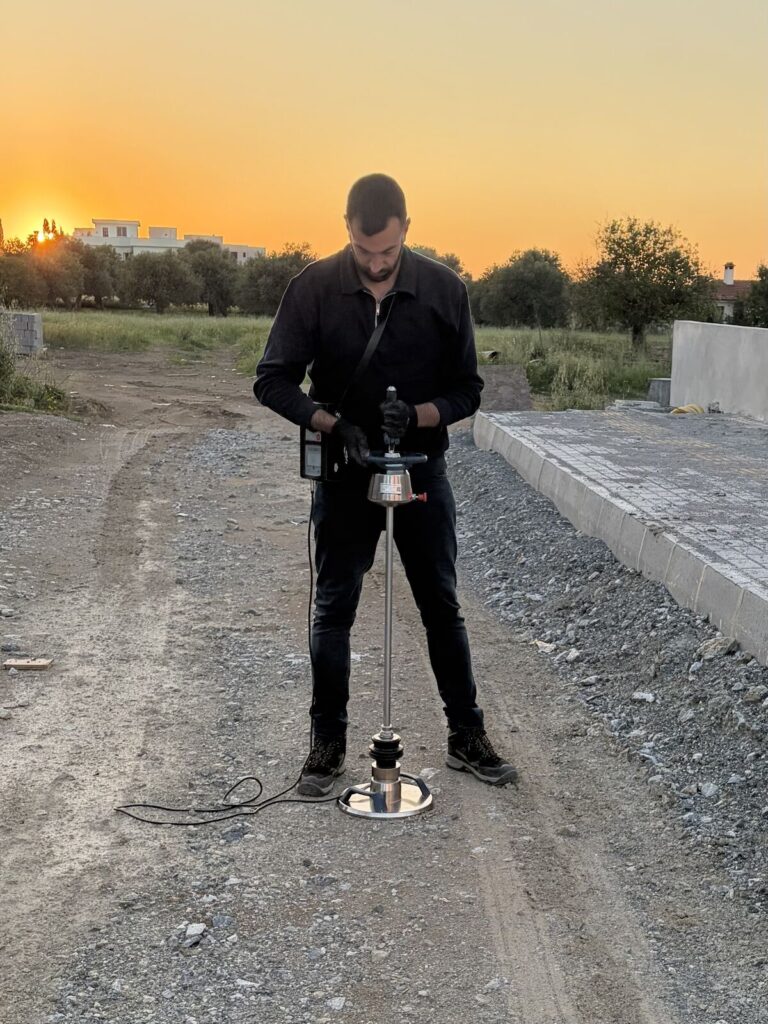
We carry out compaction and bearing-stiffness control of earthworks and unbound pavement layers with a Zorn ZFG 3.1 light weight deflectometer fitted with a 10 kg drop weight. Each test point gives the dynamic deformation modulus, Evd, on site in about two minutes, so decisions can be made before the next layer is placed. As an independent third party, we carry out and report the tests impartially.
What we test
| Test | Standard | Where | What you get |
|---|---|---|---|
| Dynamic deformation modulus (Evd), set of three drops per test point | ASTM E2835-21(2026) | Field | Evd value for each test point, on site |
| Test points typically every 20–50 m along road alignments, or on an agreed grid | — | Field | Points identified by chainage, layer and location |
| Quick checks during rolling | ASTM E2835-21(2026) | Field | Guidance for the contractor’s compaction effort |
| Retesting after re-compaction | ASTM E2835-21(2026) | Field | Retest results for re-compacted areas |
Why it matters
Evd reflects the stiffness of the compacted layer under dynamic loading, which is directly linked to how the layer will carry traffic and support the layers above it. Because a result is available within minutes, LWD testing allows dense coverage along a road without holding up the works. The method does not measure density, so where a specification sets density limits we combine it with sand cone tests. Because testing can be done on the day a layer is compacted, non-conforming areas can be re-compacted and retested before the next layer goes down.
What you receive
- Test report to ASTM E2835-21(2026) with the Evd value for each test point
- Test points identified by chainage, layer and location
- Comparison with the project acceptance value, where specified
- Summary table showing the distribution of test points along the alignment
- Retest results for re-compacted areas
- Photographs of test locations where relevant
What we need from you
- Site plan or drawings showing the areas, layers and chainages to be tested
- The project specification, including the Evd acceptance value where one is set
- Advance notice of when each layer will be compacted and ready for testing
- Safe access to the test locations, with the layer surface finished and free of loose material
- A site contact to agree the test points or the test grid with our crew
Frequently asked questions
How quickly will we have the results?
Evd values are available on site, immediately after each test point, and each point takes about two minutes. This lets you decide before the next layer is placed.
Does the LWD test replace density testing?
No. The LWD measures the stiffness of the layer (Evd), not its density. Where a specification sets density limits, we combine LWD testing with sand cone tests.
What happens if an area does not meet the specified value?
Because we can test on the day the layer is compacted, the area can be re-compacted and retested before the next layer goes down. The retest results are included in our report.
How can I check that a report is genuine?
Every report carries a QR code, a report number and a verification code. Anyone can check it on our Verify a Report page.
Guides for this service
- LWD compaction control and the Evd value
- Sand cone test and degree of compaction
- Road construction quality control: tests for each layer
Ask us for a quote for LWD compaction control; our team is on site on weekdays and weekends to match your programme.