LWD compaction control and the Evd value
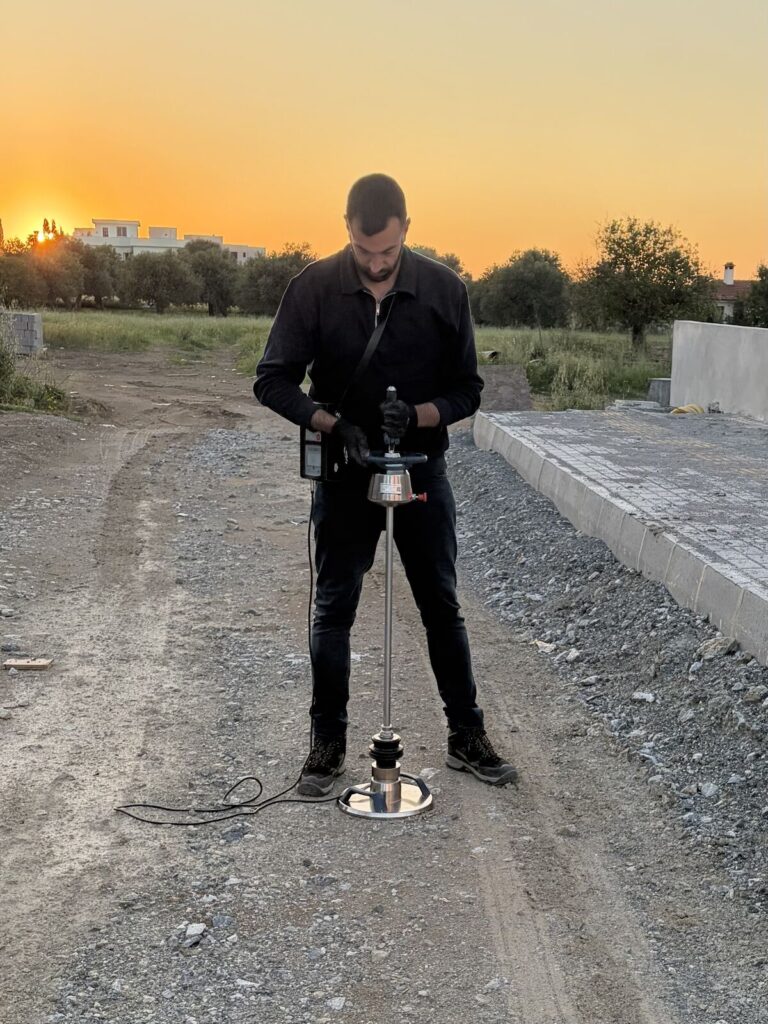
On roads, platforms and trench backfill, each layer has to be accepted before the next one goes down. The light weight deflectometer (LWD) gives the Evd (dynamic deformation modulus) at each test point on site, in about two minutes per point. This guide covers what the LWD measures, how that differs from density, where it is useful and where it falls short.
What the LWD measures: Evd
A 10 kg weight is dropped from a fixed height onto a spring-damper unit, producing a short load pulse on a 300 mm loading plate. An accelerometer in the plate records its acceleration, and the device integrates this signal twice to obtain the settlement of the plate under the pulse (s). Taking the nominal stress under the plate as constant (0.1 MN/m²), it calculates Evd = 1.5 · r · σ / s (r = plate radius), which for the 300 mm plate becomes Evd = 22.5 / s (Evd in MN/m², s in mm). The smaller the settlement, the higher the Evd. Evd describes the stiffness of the layer under a load pulse; it is not a density.
We use a Zorn ZFG 3.1 and test to ASTM E2835-21(2026). The scope of the service is on our LWD compaction control page.
Why density alone is not the whole picture
Density tells you how tightly the particles are packed relative to the Proctor reference. How well the layer carries and spreads a load also depends on its water content, the type and grading of the material and the condition of the layers beneath. Two typical examples:
- a clayey fill compacted wet of optimum may come close to the required degree of compaction yet behave softly under load;
- a well-compacted thin sub-base over a soft subgrade can still settle a great deal.
The LWD measures the stiffness of the layer system under a short load, so read together with density it gives a fuller picture of how the layer will perform.
How a test point is run
- Choosing points: typically every 20 to 50 m along a road alignment, or on a grid agreed for the project.
- Preparing the surface: loose material is removed and the plate is placed on a flat, level surface in full contact. If the plate rocks or sits on loose grains, the point is prepared again.
- Seating drops: preliminary drops bed the plate in; they are not used in the result.
- Measurement: three measuring drops are made; the device records the settlement of each and calculates Evd from the mean. If the three settlements differ markedly, the material may still be compacting under the drops.
- Recording: Evd, mean settlement and the point reference (chainage, layer, location) are logged. The result is known on site in about two minutes per point.
The site should provide a compacted layer, chainage or grid references for the points, the acceptance value from the specification and, on roads, traffic management. Rollers should not work near the point during the measurement.
Where the LWD fits
- layer-by-layer acceptance of subgrade, fill, sub-base and base on roads,
- building and site platforms,
- trench backfill, where the trench is wide enough to seat the 300 mm plate,
- intermediate checks during rolling.
Because no hole is dug, many readings can be taken along long road sections and trench runs, which pins down weak areas clearly. The test can be run on the day the layer is compacted, so weak areas can be re-rolled and retested the same day. Where the specification gives an Evd acceptance value we compare the results with it; that value is not universal and is set for the layer and material in the project.
Limits
- Water content: Evd is sensitive to it. On the clayey soils common in Cyprus it reads low after rain, and a crust dried by summer heat can read higher than the layer deserves. Compare results taken in similar conditions.
- Layer thickness: the reading reflects the layer system to a depth of the order of the plate diameter. On a thin layer the one below contributes; in a very thick single lift the lower part is not fully represented. Test each lift on its own surface.
- Coarse rockfill: the plate rests on a few stones and the readings scatter, so results need careful interpretation.
- Not a density test: the LWD does not measure density. Where the specification asks for a degree of compaction, a sand cone test is still needed.
- Bound layers: the method is for unbound soils and granular layers, not asphalt or concrete.
- Conversions: there is no general factor between Evd and static plate load test results; any relationship is specific to the material and site.
Using LWD with the sand cone and Proctor
Our recommended approach: on the first layer, run both the LWD and the sand cone test (ASTM D1556/D1556M-24, TS 13872:2019+T1:2026) at a few points, with the Proctor reference determined in the laboratory to TS EN 13286-2:2013. That gives a first indication of how Evd relates to the degree of compaction for that material. After that, the LWD covers a dense grid of points, and the sand cone test covers the frequency the specification requires plus the points with the lowest Evd.
The DCP (ASTM D6951/D6951M-18(2023)) is a different tool: an 8 kg hammer drives a cone into the ground, giving a profile of penetration resistance with depth, layer thicknesses and an estimated CBR. The LWD gives the response of the layer system at one point on the surface; where a depth profile is needed we use our site investigation and DCP service.
Frequently asked questions
Can the LWD replace the sand cone test?
Only where the specification accepts layers on Evd. If acceptance depends on the degree of compaction, the LWD is a complement and the sand cone test is still required.
What Evd value is good enough?
The project specification sets it, and it varies with the layer, the material and what will be built on top. If no value is given, we report the results as a distribution table and suggest reviewing them with the designer.
Can you test after rain?
Yes, but on wet clayey layers Evd reads low and changes as the layer dries. For acceptance readings we recommend waiting until the layer is back to its normal water content.
To plan layer acceptance around your programme, see our LWD compaction control service and send us your specification through our contact page.