Sand cone test: in-place density and degree of compaction
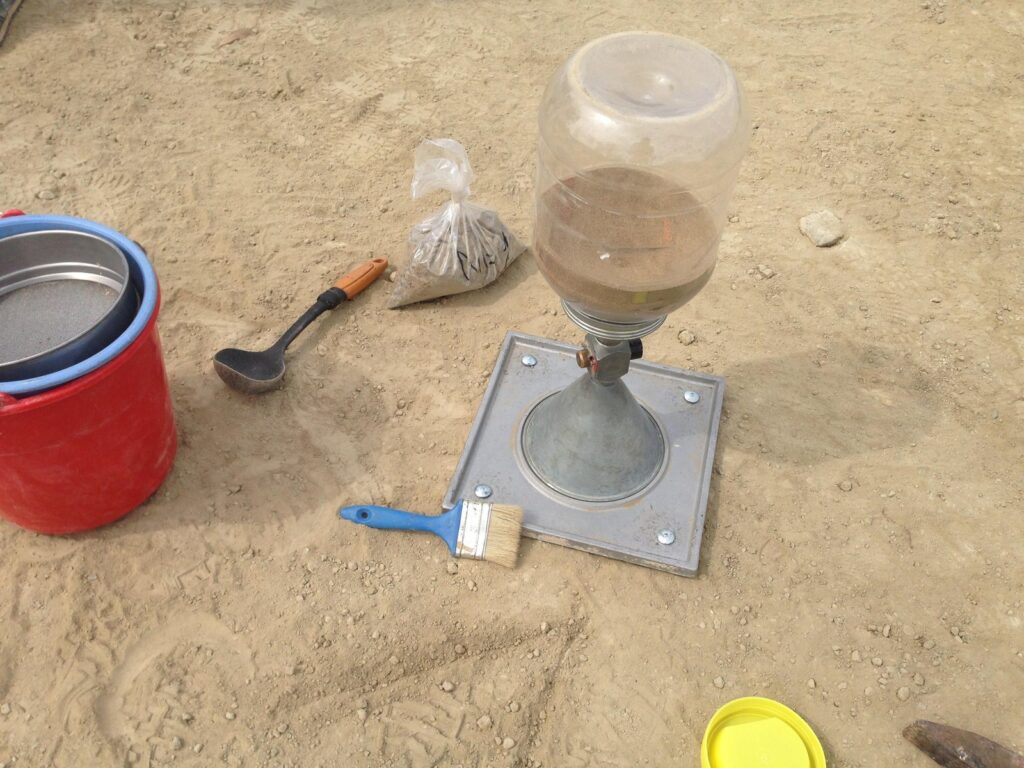
Once a fill, subgrade, sub-base or trench backfill layer has been placed and rolled, the question is always the same: is it compacted enough? The sand cone test answers it by comparing the dry density measured in place with the Proctor reference determined in the laboratory. Below we explain when the test is needed, how it is done, how the degree of compaction is calculated and the mistakes we see most often in Cyprus.
When is a sand cone test needed?
Whenever the project specification ties acceptance of a layer to the degree of compaction. Typical cases are:
- controlled fill for building and site platforms,
- subgrade, sub-base and base layers on roads and car parks,
- trench backfill for water, sewer and cable lines, compacted in lifts,
- backfill behind retaining walls and around foundations.
The specification sets the testing frequency. Where it is silent, we usually test about once per 1,000 m² of each layer; in trenches the points are spread along the run and repeated for each lift. The scope is described on our sand cone density testing page.
How the test is carried out
We follow ASTM D1556/D1556M-24 and TS 13872:2019+T1:2026:
- Calibration: the bulk density of the test sand, and the mass of sand that fills the cone and base plate, are established beforehand. The sand must be dry, clean and free-flowing.
- Surface preparation: loose material is removed, the surface is trimmed level and the base plate is seated.
- Excavation: a hole is dug through the plate to the thickness of the layer under test. All the excavated material goes into a sealed container, so no water is lost, and is weighed.
- Volume: the cone is inverted on the plate, the valve is opened and the calibrated sand fills the hole. The hole volume is the mass of sand used, less the mass that fills the cone and base plate, divided by the bulk density of the sand.
- Water content: determined in the laboratory by oven drying to TS EN ISO 17892-1:2014+A1:2022.
- Calculation: bulk density = mass of excavated material / volume of hole; dry density = bulk density / (1 + w), with the water content w as a decimal (for example 0.08 for 8%).
Why the laboratory Proctor test is the reference
A dry density figure on its own is neither good nor bad: the same value may be high for a clayey fill and low for a crushed-stone sub-base. Each material needs its own reference. In the Proctor test (TS EN 13286-2:2013) specimens of the same material are compacted at a range of water contents with a defined effort, giving the maximum dry density and the optimum water content. The specification states whether standard or modified Proctor applies.
The reference must represent what is being placed; if the source, material type or grading changes, a new Proctor test is needed. We run it in our soil laboratory, and bringing the sample in before field testing starts saves time.
Calculating and reading the degree of compaction
Degree of compaction (%) = in-place dry density / maximum dry density × 100
For example, 2.05 Mg/m³ in place against a maximum dry density of 2.15 Mg/m³ gives about 95.3%. There is no universal pass mark: the acceptance value depends on the layer, the material and the Proctor method, and comes from the project specification. For each point our report gives bulk density, water content, dry density, degree of compaction and the Proctor reference used. Some specifications also limit the field water content relative to the optimum, so read the two together.
Because dry density depends on the oven-dried water content, results are normally reported within 1 working day.
Site preparation and common mistakes
Before we arrive, please have ready a layer that is fully compacted and at its final level, chainage or grid references, a description of the layer and material, and the acceptance value and Proctor method from the specification. On roads, traffic management must be in place, and rollers should not work near the test point during the test.
The mistakes we see most often in Cyprus conditions:
- Testing straight after watering: in summer the surface dries fast and is often watered just before testing. The top is wet, the body of the layer dry, and the water content no longer represents the layer. Water belongs before compaction, not before testing.
- Oversize stones: coarse stones in the hole that were not in the Proctor sample make the dry density read high. The standard apparatus is not suited to materials with an appreciable proportion of particles above about 38 mm; we note such cases in the report.
- Wrong layer: digging into the layer below, or leaving loose material on top, mixes two layers in one result.
- Unrepresentative points: testing only the centre strip the roller has covered most. Edges, the foot of trench walls and the ground around manholes are harder to compact and should be included.
- Vibration and damp sand: a roller working nearby while the sand runs, or sand that has picked up moisture, distorts the hole volume.
Sand cone or LWD?
| Feature | Sand cone | LWD |
|---|---|---|
| What it measures | In-place density and water content | Evd (dynamic deformation modulus) |
| Reference | Proctor maximum dry density | Evd value set in the specification |
| Time to result | Within 1 working day | About two minutes per point, on site |
| Standard | ASTM D1556/D1556M-24, TS 13872:2019+T1:2026 | ASTM E2835-21(2026) |
The LWD does not measure density, so it cannot replace the sand cone where the specification asks for a degree of compaction. The two work well together: LWD compaction control covers many points quickly and finds weak spots, while the sand cone gives the degree of compaction the specification requires.
Frequently asked questions
How many tests do we need?
The specification decides. Where it does not, we test about once per 1,000 m² of each layer; on narrow trenches and small platforms we use enough points to represent the whole area.
The result came out above 100%. Is that possible?
It can happen if the compactive effort on site exceeds the laboratory effort, but more often the Proctor reference does not represent the material placed, or there were oversize stones in the hole. We then review the reference with you.
What happens to an area that fails?
It is re-compacted, with the water content adjusted if needed, and we retest at the same location. Retest results are shown separately in the report.
For acceptance testing of fill or pavement layers, see our sand cone density service and send your programme and specification through our contact page. We attend site on weekdays and at weekends.