Sand cone in-place density
Is the fill, subgrade or base layer compacted enough? We measure the in-place density on site with the sand cone method and compare the dry density with the Proctor reference from our laboratory.
Get a QuoteRead the guide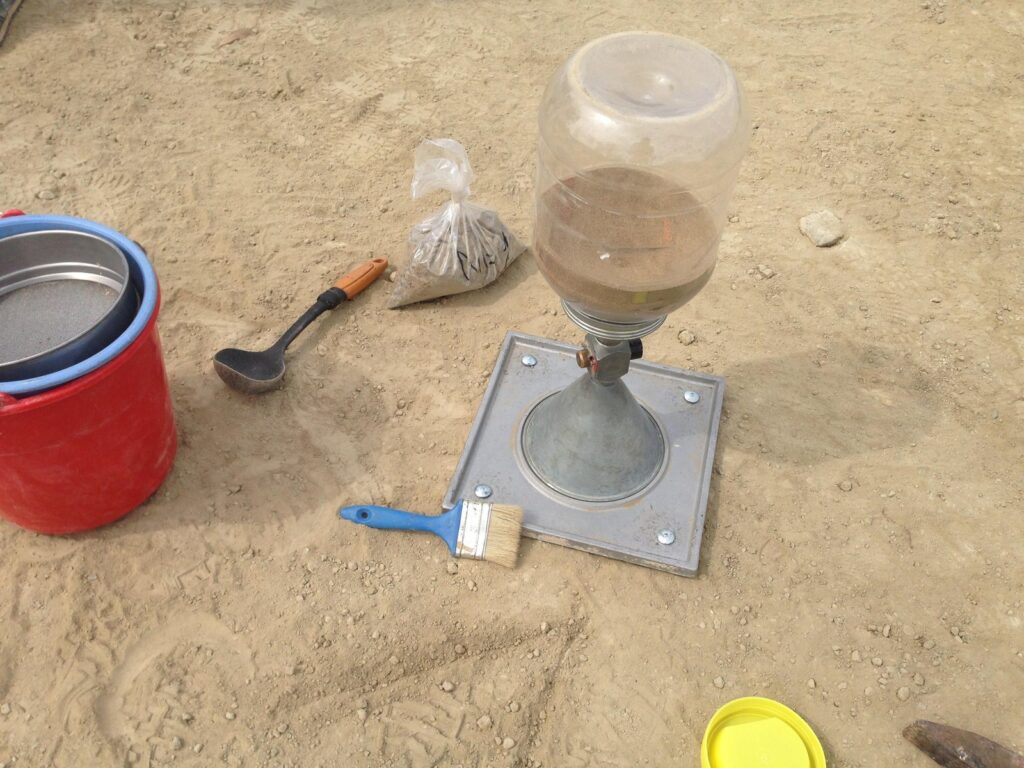
We determine the in-place density and water content of compacted soils and granular layers using the sand cone method. Combined with the laboratory Proctor result for the same material, the test gives the degree of compaction that most earthworks and pavement specifications use as their acceptance criterion. As an independent third party, we carry out the measurements on site and report the results impartially.
What we test
| Test | Standard | Where | What you get |
|---|---|---|---|
| In-place bulk and dry density | ASTM D1556/D1556M-24 TS 13872:2019+T1:2026 | Field | Bulk and dry density at every test point |
| Calibration of the test sand and sand cone apparatus | ASTM D1556/D1556M-24 TS 13872:2019+T1:2026 | Lab | Calibration values used in every density calculation |
| Water content by oven drying | TS EN ISO 17892-1:2014+A1:2022 | Lab | Water content of the material excavated from the test hole |
| Degree of compaction relative to the Proctor maximum dry density | TS EN 13286-2:2013 | Field + lab | Degree of compaction, with the Proctor reference used |
| Retests after re-compaction | ASTM D1556/D1556M-24 TS 13872:2019+T1:2026 | Field | New results for re-compacted areas |
Why it matters
Density is the most direct measure of how well a layer has been compacted, and insufficient compaction leads to settlement, loss of bearing capacity and early pavement distress. The sand cone method measures the volume of the test hole with calibrated sand, which makes it applicable to a wide range of soils and granular materials. Because results depend on oven-dried water content, they are typically available within 1 working day.
What you receive
- Test report to ASTM D1556/D1556M-24 and TS 13872:2019+T1:2026 for each test point
- Location, layer and chainage or grid reference for every test
- Bulk density, water content, dry density and degree of compaction
- The Proctor reference used (maximum dry density and optimum water content)
- Photographs of test locations where relevant
What we need from you
- Site plan or drawings showing the areas to be tested, with layers and chainages or grid references
- Specification targets: the required degree of compaction and the test frequency
- The Proctor reference for each material, or a representative sample so that we can carry out the Proctor test in our laboratory
- Safe access to the layer once compaction is complete
- Advance notice of when each layer will be ready, so that we can schedule our crew
Frequently asked questions
How quickly do we receive the results?
The test is carried out on site by our crew, and results are delivered within 1 working day. Our field work hours are 08:00–18:00.
Why is a Proctor result needed?
The sand cone test gives the dry density of the layer in place. The degree of compaction is that dry density expressed as a percentage of the maximum dry density from the TS EN 13286-2:2013 Proctor test on the same material, so each material needs its own Proctor reference.
How many tests does a layer need?
Typically about one test per 1000 m² of layer, or the frequency your specification requires. Where an area does not meet the requirement, we retest it after re-compaction.
How can I check that a report is genuine?
Every report carries a QR code, a report number and a verification code. Anyone can check it on our Verify a Report page.
Guides for this service
- Sand cone test and degree of compaction
- Proctor, CBR and water content tests
- Road construction quality control: tests for each layer
Ask us for a quote for sand cone density testing; we attend site on weekdays and weekends to suit your programme.