Aggregate testing: grading, Los Angeles, methylene blue, shape
However well a concrete mix, asphalt layer or granular base is designed, it will not perform if the aggregate in it is unsuitable. This guide covers the aggregate tests we run most often, how to sample a stockpile, how much to bring and how to read the results.
Why aggregate quality matters
Aggregate makes up most of the volume of concrete and almost all of an asphalt mixture or a granular base and sub-base. Its grading, cleanliness, particle shape and resistance to fragmentation directly affect the workability, water demand and strength of concrete, the void structure of asphalt and how well bitumen bonds to the stone, and how well a base compacts and carries load. Poor aggregate is often noticed late on site; testing exposes the risk before the material is used.
The tests and what they tell you
These tests form the core of our concrete and aggregate testing work.
Sieve analysis (grading) – TS EN 933-1:2012
The sample is dried, weighed, washed over a 0.063 mm sieve to remove fines clinging to the particles, dried again and passed through a nest of sieves. The result is the percentage passing each sieve and the fines content (below 0.063 mm), shown as a grading curve. Dust coating crushed rock makes the fines content look low if the material is only dry-sieved, so the washing step matters.
Los Angeles resistance to fragmentation – TS EN 1097-2:2020
A specified size fraction is turned with steel balls in a drum for a set number of revolutions, and the proportion passing the 1.6 mm sieve is found. This is the Los Angeles coefficient (LA): the lower the value, the tougher the aggregate. Stone that crushes under rollers and traffic changes the grading of the layer in place.
Methylene blue – TS EN 933-9:2022
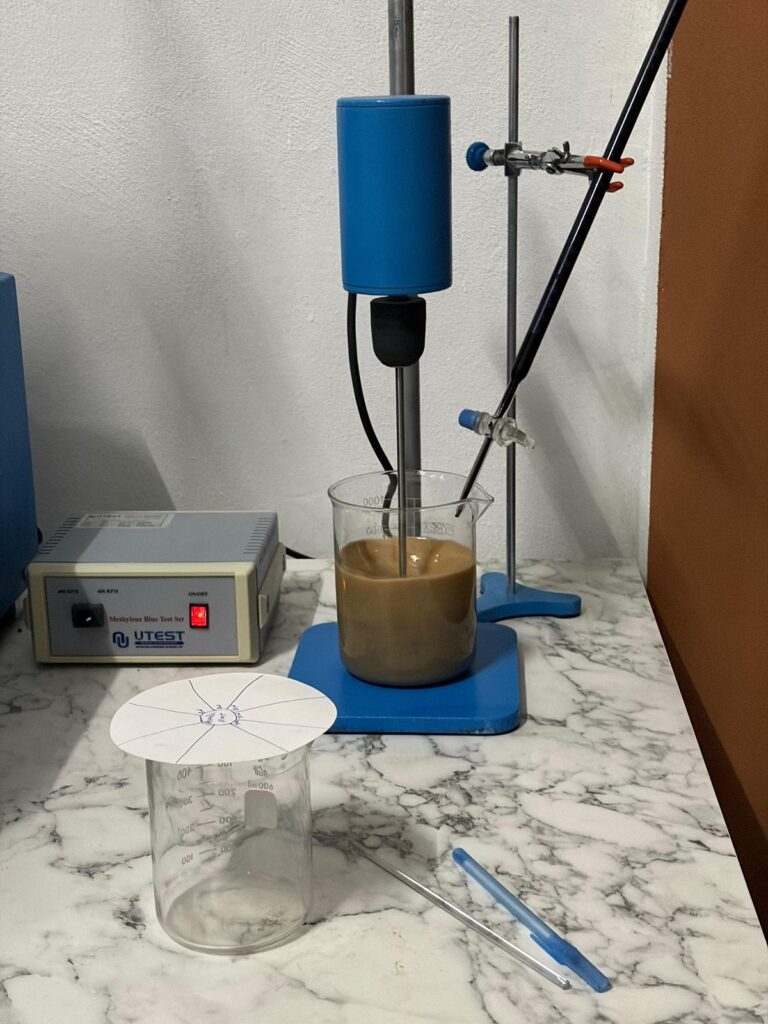
Methylene blue solution is added step by step to a suspension of the 0/2 mm fraction, and drops on filter paper show when the dye is no longer adsorbed. The MB value is given in grams of dye per kilogram of the 0/2 mm fraction. It helps to tell harmless rock dust from clay, which reacts unfavourably with water and binder.
Particle density and water absorption – TS EN 1097-6:2022
The aggregate is soaked for 24 hours and weighed saturated surface-dry and oven-dry, using the wire basket or pyknometer method depending on particle size. Results are particle densities (Mg/m³) and water absorption (%), needed for volume and water corrections in concrete mix design and for asphalt volumetrics.
Flakiness and elongation indices – BS 812-105.1:1989 and BS 812-105.2:1990
Particles retained on the 6.3 mm sieve are split into size fractions and passed through thickness and length gauges. A particle thinner than 0.6 times the mean size of its fraction is flaky; one longer than 1.8 times is elongated. Each index is the percentage by mass of such particles. These particles tend to break during compaction, reduce workability and weaken interlock.
Sampling a stockpile, and how much to bring
A result is only as good as the sample. On a conical stockpile the coarse particles roll to the toe, while fines are blown off the surface or washed down by rain. General good practice:
- If a loader is available, cut into the pile, spread the material in a small flat heap and take increments from several points.
- Otherwise take increments from the bottom, middle and top at points spread around the pile, shovelling away the outer layer first.
- Combine and mix the increments, and bag each fraction (for example 0/4 and 4/16 mm) separately.
- Use clean bags that hold the fines; line woven sacks with a plastic bag.
- Label each bag with material and fraction, quarry or supplier, stockpile, date and intended use.
If we take the sample, we record the location and conditions; if you bring it, the results apply to the sample as received. The quantity depends on maximum particle size and the tests required, and we reduce it in the laboratory to the portions the standards call for. As a starting point:
| Material | Tests | Approximate quantity |
|---|---|---|
| Sand or crushed sand (e.g. 0/4 mm) | Grading, methylene blue, density and absorption | 10 kg |
| Coarse aggregate, per fraction (e.g. 4/16 mm) | Grading, Los Angeles, flakiness and elongation, density and absorption | 40 kg |
| Base and sub-base material (e.g. 0/31.5 mm) | Grading, Los Angeles, methylene blue | 50 kg |
Grading alone needs less; material short of the size range used in the Los Angeles test may need more.
Who uses these tests
- Quarries: routine product checks, retesting when working moves to a new face, documentation for buyers.
- Ready-mix plants: incoming aggregate checks, grading, density and absorption for mix design, methylene blue on sand.
- Asphalt plants: Los Angeles, flakiness, cold-feed grading and particle density for volumetrics.
- Contractors and supervising engineers: confirming base and sub-base material meets the specification before it is laid.
- Self-builders: anyone mixing concrete on site can have their sand and gravel checked.
Reading the results: limits come from the specification
Our reports include a grading curve and a summary table of aggregate properties for each sample. There is no universal pass mark: the same material may suit a sub-base but not an asphalt surface course. Limits come from the product or project specification. Tell us which specification applies and where the material will be used, and we will show the results alongside those limits; a statement of conformity is given only where agreed in advance. Check that the grading curve sits within the specified envelope; lower LA and MB values are better; high flakiness and elongation mean a shape prone to breaking; high absorption means part of the mixing water or bitumen will go into the stone.
Common mistakes in Cyprus conditions
- Sampling from the toe, from a surface dried out in summer, or from the base where fines collect after rain.
- Mixing fractions in one bag, or losing fines through a torn sack.
- Not retesting when the quarry or face changes. Geology in Cyprus varies over short distances, and clay or marl bands can end up in the fines of crushed material.
- Expecting a pass or fail answer without telling us the specification.
Frequently asked questions
How long do results take?
Drying the sample takes much of the time, and density and absorption take a little longer because of the 24-hour soak. We give you an expected date when we receive the sample.
Is the quarry’s old test certificate enough?
Results relate only to the sample tested, and properties change with production conditions. Specifications usually require the material delivered to your project to be tested at a stated frequency.
The methylene blue value is high. Is the material unusable?
That depends on the limit in the specification. If it is exceeded, washing the sand or changing the source may be options, and we can retest the washed material.
Bring samples to our laboratory or ask us to take them; we work on weekdays and at weekends around your pour and delivery schedule. See our aggregate testing service page for the scope, or contact us to agree the test list and sample quantities.